bored with Picasso


Art History seems particularly prone to the opposition of Great Principles. Like “Abstraction versus Representation” or “Essentialism versus Individualism” or “Idealism versus Realism”.

Quite an age-old philosophical debate of course – the permanence and universality of “essences” or “abstract categories” versus the fleeting profusion of individual things and humans, which are but poor, imperfect instances of ideal types and universal concepts.

In art the tension between these poles has taken on many different guises.
An Italian early renaissance painter would have aimed at universality through the painting of ideal specimens – his Northern counterpart would have rendered reality in all its teeming diversity: painting real landscapes filled with a great many of real people and bathing in real light .
And what by now has turned out to be the mainstream art of the 20th century, once declared itself revolutionary in its reneging on realist representations - blithely going for abstractions and concepts. (1)

I’m not going to choose sides here. I am too fond of the plurality of schools and currents in art, and of how they show the diversity of human thought and perception. (2)

But there is a certain kind of formulatic abstraction in art, which seems to me a gross and boring de-humanization of reality. And then I think of two figures who loom large in art history: Picasso and Raphael. Bien étonnés de se trouver ensemble, I admit. (3) Both are outstanding visual virtuoso’s . And at one time I have certainly been impressed by their work, and by the creative energy and the continuous visual reinventions of Picasso in particular.

But how utterly bored I have become with them … perhaps because of their shallowness of feeling, a shallowness disguised in formal virtuosity. Theirs is the kind of formalism that can only for a short while pose as “universality”.
To me, now, Picasso is the leering, predatory gaze at its abstracting and reductionist worst – in his work any remaining traces of individual human presences have been reduced to grotesque symbols of anonymous lust. (4) And Raphael … his madonna’s could of course hardly be accused of being lust-objects – no, theirs is a different anonymity: that of the cloyingly insipid, sentimental cliché.

And that’s my point: anonymity is not the same as universality. The universality of the human condition is not to be found in abstractions without empathy … the universality of the human experience can only be found, burning in each passing moment, in each individual man or woman, in lives marked by time. (5)

And how can an artist render that universality? By his or her attention and respect for the individual. And must the artist then merely copy and represent appearances? Why no – it’s rather a question of recreating an existence , an experience – which means incorporating more than first meets the eye, going beyond appearances to capture life. (6) Art may well be a matter of love then … yes, if beauty is in the eye of the beholder then thre must be love in the eye of the artist.

So no wonder I was moved by a current exhibition of Lucian Freud paintings (7) The way he renders the ravages of flesh – the bulkiness of a body – the interiority of a gaze. He is a realist – he is not afraid of repulsive realities – he is not afraid of mortality – he does not beautify in the conventional, idealist sense.
But he honors his models, oh yes he honors them by granting them an absolutely, radically individual existence.

Hence, how intensely do I disagree with the eminent art critic David Sylvester who found that Freud’s work lacked a sense of the human condition, because it would be wanting in “universality”: “ Freud seems to see the world at close range through his own eyes only, painting attractive or repulsive sights according to his personal whim.”

But another critic, Martin Gayford, comes brilliantly to Freud’s defense: “it is Freud’s treatment of the world as made up entirely of unique individual things that is his greatest strength. He has resisted the tendency of modernist art to subdue the complexity of the world to a style or a concept […] to Freud, everything has a degree of individuality. Consequently, everything he paints is a portrait. Every such work is a personal encounter”.

And therefore one stares and stares at Freud’s paintings – at those intensely individual people, so vulnerable in their imperfections, so utterly subjected to time, so very much there and part of a lumpy and often pasty reality, recreated in paint.


Um, a couple of foot-notes, yes :
(1) But in the very long history of (not only western) art, it is not realist representation that is the dominant tendency. Abstract and ornamental art, or symbolic art illustrating religious revelations, seem to be much more preponderant. So it would rather be the attention for individual human existence and experience which is the exception, and therefore revolutionary ....
(2) Very brief ode to diversity in art: I love Cézanne’s solidly deconstructed fragments of reality, Kandinsky’s tormented spiritual abstractions, El Lissitzky’s playful forms suspended in mid air. I adore the limpid beauty and clarity of the 16th century Venetians as well as the 17th century brooding chiaroscuros. I am moved by the quality of textures and light in 15th century Flemish painters as I am by the tactile sense of volume of their Italian colleagues.
(3) Strange bed-fellows
(4) The profusion of works done by Picasso in old age have so abundantly exploited his cubist tricks that they have become empty formulas. And then his lust for life and sex, at a younger younger age perhaps still inspiring awe because of its sheer vitality (though already repulsive in its egotist loveless-ness) – finally dissolves in numerous pathetic sketches of bouncy old satyrs lusting after meekly reclining female models . And his in-humaneness is not just an inevtable corrolary of abstraction: even in his classical/monumental phase the humans he paint lack all individual life. There’s only his blue, “pathetic” period that may offer a glimpse of possible human sympathy.
(5) But perhaps Picasso – with his utter disrespect for the individual – did offer a cruelly relevant mirror to the 20th century : a century which in Europe was brutally marked by ideologies that cared very little indeed about individual lives.
(6) In that sense a painted portrait will always outdo a photograph – the painter can put in his painting layers of feelings & attitudes & thoughts & lived life & undercurrents & hints & guesses – layers an objectively registering camera-eye could never register.
(7) A Retrospective at the Gemeentemuseum in The Hague - I first came under the spell of a Lucian Freud painting over 10 years ago – “standing by the rags” – the vulnerability of flesh – the way that head rested on the arm , the tactile presence and texture of both flesh and rags …


What kind of blog-posts could an Easter-Monday yield?


1) The frivolous option

Well, I could have a go at a blatantly frivolous post – filled with grinning Easter bunnies & melting chocolate eggs. But, um, 't was rather the snow that was melting this morning, when I cycled through the wintry park, which was incongruously full of spring flowers and twittering birds. And with big blobs of wet snow falling off the tree- branches, and a wet frosty air one could get drunk on, while swoosh-ingly riding uphill.

2) The tragic option

But on the other hand. Easter! Such an opportunity for deep & doom-laden reflections! With its great tales of Suffering, Passion and Resurrection … And yes, later this day I may still very well switch off the phone, draw shut the curtains and immerse myself once again in one of Bach’s passions, these heartrending and ultimately redeeming reenactments of intensely humane passions - anguish, humiliation, treason, guilt, pain, love, sorrow , hope …

How not to feel moved by the Agony in the Garden - when this man, utterly forsaken and alone, prays to “let this cup pass from me”. How not to shudder at the torture of this “man of sorrows” , “derided, mocked and spat upon”. It is of course telling that, a few years ago, while contemplating a 15th century print of “the Mocking of Christ” (1) , I actually recognized the expressions of cruel glee on the faces of the persecutors: it were the very same expressions of sadistic delight as one could see on photos that circulated at the time, photos of the torturing at the Iraqi prison Abu Ghraib.


So yes, the human condition being what it is, I can quite relate to the need for redemptive stories about a god who sends his son to partake, up to and including his very death, in agonizing human suffering.

3) The true story option

But of course I can also quite understand the need to celebrate budding flowers, fertile bunnies and tasty chocolate eggs. So for once, I might try not to give in to my penchant for ponderous posts.

And I might try to fill the page with more lively stuff, eg with an account of last Saturday’s pilgrimage, together with a friend, to Oscar Wilde’s and Marcel Proust’s graves at the Père Lachaise cemetery.

Yes, I could tell about Saturday’s photo-shoot adventures with M. in Paris! About the transportation of a tripod and a bag full of cameras in crowded metro-cars . About a raincoat (not mine!) carelessly cast aside in a downpour, only to be appropriately attired (il faut souffrir pour l'art) for a frivolous tribute to dear Oscar: a pink-glossed lipstick kiss pressed on his slightly pompous white tomb (again: not my lips!). Or about the waiting for the errant sun to break through the clouds so as to be able to take a photo of a shadow falling on Proust’s grave (quite a modest black stone), but for lack of enduring sunlight we had to resort to a black umbrella silhouette picture instead (yes, my silhouette and my umbrella this time). Or I could tell about the two cute and obliging boys with a map, who helped us to locate Sarah Bernhardt’s tomb, far less flamboyant a tomb than expected. And about M. bravely soldiering on with her dandy-esque boots, limping on the cemetery’s pathways paved with cobble stones.

4) Degenerating anyhow into needlessly ponderous ruminations

Ay, but can I just like that put M. in a story of mine ? I must confess here that I suffer from an outrageous kind of almost superstitious discreetness: thou shall not make likenesses of living people – thou shall not appropriate other people’s existences for your stories.
And surely that’s why, though an avid street photographer, I rarely take photos of people in the street: who am I to think that I could sum up what they really are about? Or, alternatively, who am I to merely take a photo of their appearance in a brief moment of existence, without bothering to capture their essence? And if I could capture other people’s souls, who am I to publicize them on my blog? So this blog as well as my Flickr-photo-pages are to remain eerily depopulated … ?

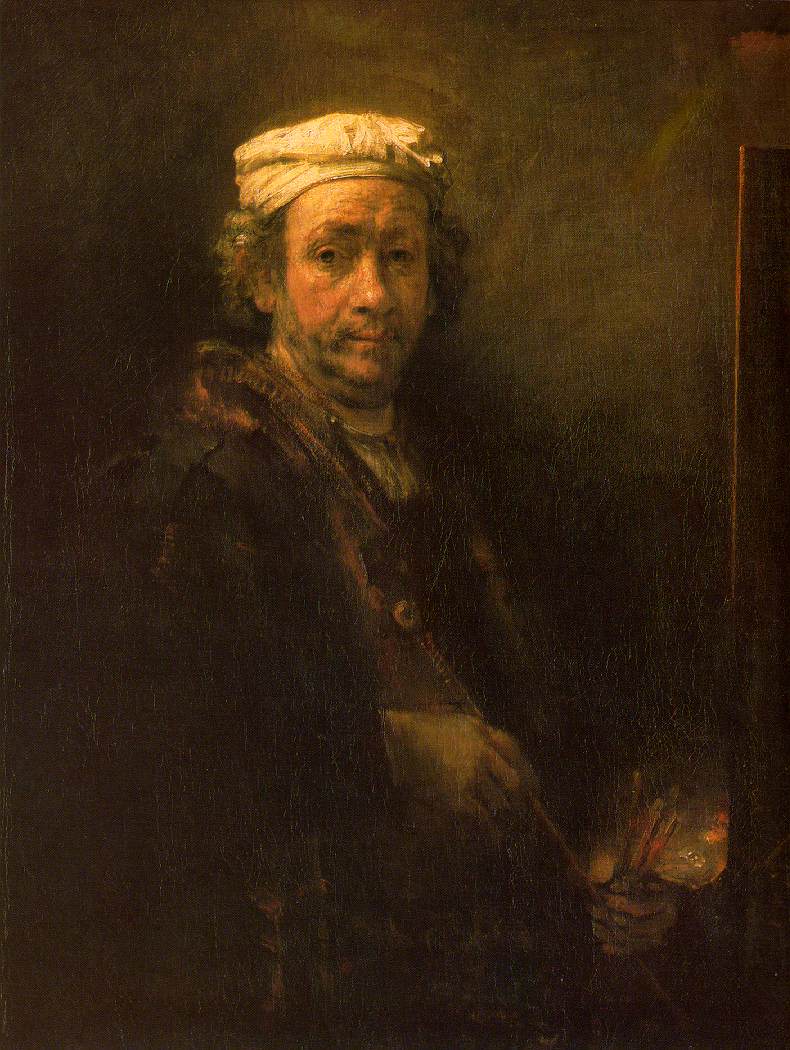
Ah, portraits …. Whether it are pictures in papers or magazines, taken by a professional photographer, or just snapshots, it’s rare that, starting from a mere portrait of someone I do not know, I feel able to fathom that person’s soul. I’ve often gazed at photos of unknown people– but however accurately they render each physical detail , however long & intensely I stare, I cannot make out who is behind that face. Maybe painters can do it, have the outer form reflect the inner workings of the soul? Like Rembrandt’s self-portraits – where every wrinkle and fold of his ravaged face cries out to our hearts.
Well, perhaps self-portraits are always more telling, expressing what the artist or the photographer wishes to express about her- or himself?

Oh and then there are the photos of people I do know personally, of people I love …. How evocative and poignant the portrait then becomes! Because the portrait then is a reminder, a token of everything we love and appreciate in that person. And because it allows us to sense the whole of the person in one intuitive, instantaneous grasp that no literary description could ever offer.


(1) the picture is not Schongauer’s “Mocking of Christ” (did not find a reproduction of that one) , but his “Carrying of the Cross” , scanned out of the Colmar-museum catalogue

oh, Vienna .......


There is no escaping from the curse of a wandering, reflective mind. Refusing to be completely engrossed in any single activity, this kind of wayward mind will always stubbornly branch out into numerous ruminative thought-streams. Though clearly not a recipe for swift practicality (1), this affliction does bring precious moments of illumination. For instance, when two or more streams of consciousness suddenly meet and echo each other - then the whirling thought-threads momentarily seem to cohere in a tapestry that connects past and present, reality and imagination - and offers a glimpse of meaning (2) .

So when I sat there waiting for the plane to Vienna, I was not just preoccupied with the logistics of travelling, but also worrying about the next day’s meetings. And chewing on the past weekend’s events. And reminiscing about another Vienna-trip, so many years earlier (by night train! which had seemed a romantic idea at the time, but had me arriving exhausted and rattled).

But most of all, sitting in that waiting area, I was still immersed in the tragic suspense of the book that has been haunting me for the past weeks : Daniel Mendelsohn’s “The Lost” – a book in which he relates his meandering quest to find out more about the Polish branch of his Jewish family, in particular about a certain family of six, a mother and father and four daughters, who have all perished in the Holocaust.
His odyssey throughout the world, in search for witnesses, for memento’s, brings him also to Vienna. Vienna, which before the war used to be an intellectual centre of European Jewry, but now …, now... , as Mendelsohn wryly writes home on a postcard, : “Vienna is still beautiful, but no Jews – not even dead ones” (3).
And therefore, I am particularly moved, when amongst the waiting passengers I notice two Orthodox Jews and a man wearing a yarmulke.

When the plane lands it is already dark – with the neon lit airport buildings looking desolate and sinister. I wring myself into the airport shuttle bus, already cram-full with tall and heavy-set males, all speaking ominous, guttural languages (Polish? Czech? Russian?), all looking particularly ruthless & tough. When hailing a cab at the taxi-stand, I am relieved to see a female taxi driver pulling up. We drive on in silence, past eerily lit gleaming smokestack industries, and then through deserted suburbs with old and large apartment-buildings - which must have witnessed quite some spooky scenes ... in the thirties under streetfighters' & nazi-rule ... in 45, during the looting & plundering & free-for all "liberation" by the Russian Army... .

Only at the hotel the menacing air makes way for a more placid Viennese atmosphere – with its faded carpets, its once-elegant furniture, its prints of long forgotten famous men on the wall, the hotel room exudes a slightly decayed formality and feels oddly provincial. But then, what else is Vienna, but a provincial outpost still decorated as the capital of an empire?

The next morning I get up an hour too early by mistake (my mobile’s clock lives in its own time zone). I only realize this in the U-Bahn, on my way to The Important Business Meeting. At the fourth station with a clock stubbornly telling me it is only 8 and not 9 AM – I’m forced to admit that it may perhaps be my own time-keeping which is off (so that’s why I was alone at the breakfast table …). But oh, blessed be the cunning ways of my distractedness, offering my otherwise too dutiful self a clandestine hour of free roaming.

So I have time to look at the art deco gates of the city park, to wander off a grandiose street and even to sit down in a stylish Viennese Kaffee-haus with the most delicious coffee and cakes smells. It’s odd, I almost appreciate this hour of Viennese sights and smells more than I enjoyed the real Vienna tourist trip back when I was 28.
But then, perhaps Vienna is not a city for twenty year somethings … at any rate not for the doubting & searching 28 year old I was. Back then I experienced Vienna as either too cloyingly Biedermeier sweet, too Wiener Sanger Knaben, too Sound Of Music, or as too pompous & overbearing & grandiose. (4) Only now can I wistfully value its melancholy blend of frivolous fragments of past glories and of ominous reminders of Europe's great tragedies.


On the other hand, that first Vienna trip was not completely unfruitful ... – the visit, so long ago, to the vast Kunsthistorisches Museum, where I wandered about without any art historical clue, did plant the seed for my later love of Old Masters and for many an art inspired pilgrimage. And that somber, soul-searching Caravaggio painting with the young and victorious David looking wistfully at the slain head of the older Goliath… Yes that painting made me upon my return acquire a Caravaggio monography, the first of many art books to fill my book-shelves....


And so I sit reminiscing in the Kaffee-haus, soothed by the clatter of cutlery, by the sight of impeccably groomed waiters carrying off sumptuous pieces of cake to tables where patrons peruse the papers and sip their coffee. But then the hour of freedom is up and the day of role playing can no longer be delayed. ….

And now, I cannot help but wondering, what would that tormented 28-year old make of my current self? Of the years lived? The people loved? The books read? The paintings seen? The miles travelled? What would she make of the self, who later that day was sifting through business papers and data, tapping away on a laptop amongst a bunch of young, ambitious, clean shaven consultants, equally furiously tapping on keyboards. What would she make of the self who in the evening, avoiding any further business contacts, is having a pizza on her own, so as to be able to read on in the Mendelsohn book – to immerse myself again in his tragic stories.

But then again, why would I grant that 28-year old any particular rights to judge my current self? Much better to choose as a judge the boisterous & rebellious & wise 82 year old lady I will be!


No blogpost without footnotes , so here goes:
(1) people have been known to fall off their bikes while ruminating about some painting instead of watching their bike’s wheels go round
(2) no wonder I have always had this thing for polyphonic music – where independent musical lines each do their own thing, but do attain an overall harmony, sounding note-against-note (counterpoint)
(3) Upon seeing the conspicuously empty newly plotted Jewish section of the Viennse Central Cemetery, Mendelsohn muses that even “cemeteries can be bereft” . “The New Jewish Section [of the Zentralfriedhof] was largely empty because all of the Jews who, in the normal course of things, would have been buried there had, in fact, died in ways they hadn’t foreseen.”
(4) Vienna in Mendelsohn’s words: “its grandiose beauties, the epically scaled baroque and Beaux-Arts buildings whose always slightly outsized details, the inflated cornices and overwrought moldings, were once a symbol of excessive imperial self-confidence, and now can seem almost embarrassing, given that the empire for which these ornaments were designed has vanished [….] the tenacity with which it clings to discarded formalities of another era”

idolatry

Introduction (aka dodging & procrastinating)


While outside the wind is howling and rain is battering the windows I’m rummaging through bunches of old postcards. Souvenirs devoutly brought home from pilgrimages to Europe’s great museums and galleries. And the mere sight of these reproductions helps to dispel my Sunday-gloom. So often, while brooding, we pass too pessimist a judgment on life and its dreariness – all but forgetting the invigorating jolt art can bring.


Representational images & aesthetics …. by what masochistic reflex have they so often been discredited or even banned? Human history is strewn with self-righteous iconoclasts, ranging from Jewish, Christian or Islamic purists over rational Positivists to trendy, secular Post-Modernists .


And after the decline of the Antique mastery of representational art, it has been a very close call indeed for Western Art. Not only had artistic skills been lost, but also there were the deep-rooted theological suspicions of all images, nay of anything remotely pleasing to the senses.
Fortunately Christianity has always had its fair share of casuist sophistry, so the icono-phobic fundamentalists could be swayed from their ascetic course by arguing that “the dull mind rises to truth through that which is material” (1) and “man may rise to the contemplation of the divine through the senses” (2). Wise words indeed! Paving the way for an extra-ordinary blossoming of religious representational art in the next 500 years or so.


Disclaimers :
- I am not a devout catholic.
- I am not a sentimental person.
- I do not burn candles in front of effigies.


What I really wanted to write about :


Well, after having disclaimed what had to be disclaimed, I can now confess that what I really wanted to write about today is my own love of madonna’s (3) …

Take those very early medieval statues. They’re so clumsy and sturdy, and yet so suffused with love and trust. The Madonna as a solid fortress, as the Seat of Wisdom – knowing of all the worries and all the slings and arrows of this outrageous world. Or the Madonna warily looking out into the world, broodingly holding the child on her lap – stern, even with a hint of premonitory sadness. Yes, the kind of figure, full of compassion and wisdom, one could pray to in dark & violent times. Sometimes these medieval statues are in torn and worm-eaten wood – almost sharing our own transience. Is it idolatry then when I gasp and even have to fight back tears whenever I meet one of those time worn statues in a dusty museum room? (4)


Over the centuries madonna’s became ever more graceful & gracious, gently swaying with tender love. From figures painted or sculpted with honest pathos they became staples of sentimentality or of vacuous, almost abstract virtuosity. (see (5) for a rant about Raphael)
But then there is a painter such as Giovanni Bellini, whose paintings are endowed with a sense of atmosphere and light that soothes and elates. And who has painted many a sweet Madonna for many a village and city church. Sentimental? Perhaps, but a brooding, contemplative sentimentality that evokes thoughtfulness and compassion. His pictures are saved from corniness by “the imprint of sadness, that none of his madonna’s altogether lacks” (6)& (7)


No-Nonsense Footnotes and links to more pictures!


(1) Abbot Suger : pioneer of breathtakingly sensual gothic art
(2)
Pseudo-Denis : famous but obscure early 6th century theologian
(3) When you
Google-query madonna , the first two hits are about madonna, the singer…. (& she dominates the first page). Sign of the times indeed (or rather indicative of the, perhaps, hum, ever so slightly outdated nature of this pre-occupation of mine ). But anyway, here’s a primer on madonna’s in art (with lovely pictures! Do click on!!! )
(4) Blurry pictures devoutly taken in Lille, Auxerre, Namur, and one Liège Postcard
(5) I am quite allergic to the madonna’s painted by that paragon of renaissance art,

Raphael.
However formally brilliant, his madonna’s exude not an atom of felt life, give no hint of any inner life whatsoever, let alone that they would convey any intimations of human suffering.
(6) This is in fact a phrase borrowed from the art historian Friedlaender and he wrote it about another painter (Quentin Metsys), but well , it is so particularly apt for Bellini too.
(7) From the
London National Gallery site

parable of a broken toe


Though I like to insist on the bravery of cycling in car-infested cities, falling off one’s bike has little heroic appeal. Not really knowing how it happened even adds an element of silliness to it. Well, I suppose that indirectly an insistent big bad car was to blame, since it made me swerve to the right, into the gutter and WHAM, onto the ground.


But, mainly I felt stupid, shamefacedly collecting my keys and loose change strewn over the ground. And eager to restore my dignity & urban anonymity, I swiftly got back on my bike and merged again into the rush-hour traffic. The vague pain in a toe seemed a small price to pay for that daft fall.


Never ever dismiss pain in a toe! So I learned that evening and night.


Those silly inconsequential toes are pivotal, in human mobility and immobility alike. Whether I limped or walked or shuffled, whether I lay on the sofa or in bed: that toe insisted on sending out lacerating pain signals. It didn’t want me to put the right foot (to which it is alas firmly attached) on the ground, but it didn’t want that foot to be held in mid-air either. Even lying quietly still could not appease the Offended Toe, which apparently actively partakes in the most diverse states of human equilibrium.


After having thus suffered throughout a dark long night, I welcomed morning so I could call a cab and get myself to the nearest hospital. 7 AM is a funny hour at a hospital, an hour of stillness in between night shift and day-time activity. Through long empty corridors I limped to the emergency ward (which is also the ward for diverse & various casualties including toes). While I sat there waiting, the hospital slowly came to life and at the intake desk other patients arrived – equally grey with misery after a painful night. And all with their particular, anguished tale to tell to the nurse-receptionist.


Blessed be that hospital staff!!! Their competence and friendliness so soothing for sleep-deprived minds and sore toes alike. I still marvel at how they managed to combine efficiency with friendly attentiveness – both crucial for the hapless patient.


Most impressive perhaps was the medical doctor who first examined me and who dispensed the concluding treatment. She had the sort of calm authority that inspires instant respect and confidence. She clearly was at home there in her emergency ward, ready to take on whatever casualties the city would throw up at her doorstep. Ready also to deal with aggressive patients (as I briefly witnessed later). And then, amongst all the stress, still capable not only to give appropriate attention to a mere broken toe but also some much appreciated human sympathy to the silly owner of aforesaid toe. Yes, impressive she was.


Readers of this blog know I’m a bit of a pessimist regarding the human race, whose specimens have perfected their selfish and greedy urges during eons of Darwinian struggle for life. True altruism does not exist for the selfish gene. And proof abounds for this pessimist view: at its most degrading in any war-torn zone, at its most socially acceptable in economic competition.


But then there are these awe-inspiring instances of humans defying the selfish odds: like all those medics and paramedics trying to pick up the human pieces of wars and conflicts. Or just doing their thing in an urban emergency ward. Largely unnoticed, but indispensable.


S. Swann, Private Investigator (1)


It was one of those days …. I had sat idling at my desk for hours, smoking and watching the shadows of the venetian blinds advancing ever so slowly on the opposite wall. But nobody had called. Nobody needed the services of S. Swann, Private Investigator. Well, I would wait for those creeping shadows to reach the right hand corner of the wall, and then I’ d just call it a day. Cheered by this virile resolve, I started tapping an expense note for the last client I ‘d had - last month or so. Tap. Tap. Tap. This typewriter sure made a lot of noise. Tap. Tap. Tap . Then I looked up and saw a shadow behind the smoked glass door, a shadow knocking like hell on the glass….

At this point a stunning lady, clad in black, wearing a veiled hat, should enter. Upon which our cynical private eye falls in love precipitously and embarks on a tumultuous investigation fraught with danger, deceptions & double-binds. After having disentangled all kinds of plots and subplots, our private eye then finds himself again alone in his office , bruised but unbroken, smoking.

I absolutely adore these classical noir detective stories , with their wise-cracking, melancholy private eyes and their scheming, stunning ladies in black. In younger days I have devoured all the books by Chandler, Hammett, … . And nothing like those 40s and 50s black &white film versions ( ah, the iconic Humphrey Bogart with hat, trench coat , and cigarette dangling from his lips …). From the classics I then soon branched out to even tougher stuff: the mono-syllabic Mickey Spillane, the Goodis-tales from the gutter, JH Chase’s and William Irish’s dark spells and, later on, James Ellroy’s almost baroque, violent LA stories.

My living quarters of the time reflected this infatuation: they of course had blinds instead of curtains and I even had a Fedora-hat lying about on a cupboard (though I did not go as far as wearing it in public). Not to mention my youthful smoking mannerisms which sure drew upon PI theatrics. And then there were my lonely city rambles walking hours and hours on end, seeking out seedy districts, shady station neighborhoods, river quays, decaying industrial towns ), as well as my then predilection for disreputable “gin-joints” …

Well, I have curtains instead of blinds now, I quit smoking, I do not walk into gin-joints anymore and art and philosophy books have almost crowded out crime on my book-shelves. But mind you, I did pick my philosophical allegiances carefully! And my reverence for Walter Benjamin, the most poetic and urban of all philosophers, has everything to do with the redemptive narrative he offered for those days of yore, those many days spent in aimless reading and wandering.

Here was a philosopher who linked the modern city’s avalanche of sensations, its crowds of anonymous persons to the birth of the detective story. « Man is increasingly unable to assimilate the data of the world around him by way of experience », he is bombarded by sensations and bits of information without any connection. When walking the streets we encounter numerous anonymous people, all wrapped up in their private stories and interests. People can disappear into the crowd, so many things could happen at any turn of the street. But though we all share the same cramped sidewalks and undergrounds, we do not share a common experience or story, we do not know each others’ tales or secrets.

So enter the detective story, with the urban detective … who “walks these mean streets” (2) , who follows the traces, disentangles the secrets… Or enter the flâneur, the observing flâneur, who can legitimize his idle loitering & strolling by becoming a detective. “No matter what trail the flâneur may follow, every one of them will lead him to a crime”. (3)

Now I don’t know whether Benjamin has ever read any Chandler or Hammett. In any case, his discourse about detectives and flâneurs goes back to the 19th century, to Edgar Allan Poe and to Baudelaire.

Yes, to Baudelaire…. the 19th century urban poet by excellence, and whose poem “à une passante” , “to a passer by” (4) evokes the hustle and bustle of a street scene , and how, suddenly, amidst the crowd one can come under the spell of a passer by , a radiating presence , a fleeting & fatal beauty that strikes and then, is gone forever …… "For I know not where you flee, you know not where I go"

Benjamin comments: “this is the look of the object of a love which only a city-dweller experiences, which Baudelaire captured for poetry, and of which one might not infrequently say that it was spared, rather than denied, fulfillment.” (5)

This, of course, is also the kind of fatal collisions with femme fatales which Chandler & co captured for the gritty detective novel.

And the kind of collision amidst a whirling urban crowd which Edith Piaf sang about in her captivating, roiling song
“La Foule” / “The Crowd”


Read on for accompanying lyrics in the notes
(1) The kind of blog-post you get when people start talking about Chandler and philosophy (blame Phoenix!)
(2) Chandler - The Simple Art of Murder: “But down these mean streets a man must go who is not himself mean, who is neither tarnished nor afraid. He must be a complete man and a common man and yet an unusual man … He is a relatively poor man or he would not be a detective at all. He is a common man or he could not go among common people. He is a lonely man and his pride is that you will treat him as a proud man or be very sorry you ever saw him.”
(3) Walter Benjamin, “The Paris of the Second Empire in Baudelaire”
(4) Baudelaire - Les fleurs du mal « à une passante »
La rue assourdissante autour de moi hurlait
Longue, mince, en grand deuil, douleur majestueuse,
Une femme passa […]
Un éclair … puis la nuit! Fugitive beauté
Dont le regard m’a fait soudainement renaître,
Ne te verrai-je plus que dans l’éternité ?
Ailleurs, bien loin d’ici ! Trop tard ! Jamais peut-être!
Car j’ignore où tu fuis, tu ne sais où je vais,
O toi que j’eusse aimée, ô toi qui le savais !
(English Translation from Benjamin’s “On Some Motifs in Baudelaire”
The deafening street was screaming all around me.
Tall, slender, in deep mourning – majestic grief –
a woman made her way […]
A lightning-flash … then night! – O fleeting beauty
Whose glance all of a sudden gave me new birth,
Shall I see you again only in eternity?
Far, far from here! Too late! Or maybe, never?
For I know not where you flee, you know not where I go,
O you I would have loved (o you who knew it too)
(5) Walter Benjamin, “On Some Motifs in Baudelaire”
(6) les paroles de La Foule


A Tale of Two Brain Halves (1), or: Proust and the Hypothalamus


It was definitely an exciting week for Proust-lovers with a thing for popular science (2).

The press reported upon a neurological experiment (meant to relieve a patient from his eating disorder) whereby Deep Brain Stimulation of the Hypothalamus had unwittingly engendered a vivid memory recollection in the recipient of the stimulation. The patient gushed about how he remembered a long forgotten scene in a park with friends, how he recognized his then girlfriend, how he could even distinguish details of the clothes, and how everything was in full color. And when the stimulation was intensified, the remembered details became all the more vivid.

What was so particular about this déjà vu experience was that it was brought on by stimulation of a part of the brain not at all associated with conscious memory formation! The Hypothalamus is part of the limbic system and has to do with lowly hormones, with the control of primary body functions such as body temperature, hunger, thirst, fatigue …. and it is responsive to light and to olifactory stimuli.

Hmmm … primary body-functions … smell …. and involuntary memories …. Yes, this rather smells like Proust! Proust, who with obsessive attention recorded his sensations and moods and whose most moving pages describe sudden, involuntary déjà vu’s – forgotten moments resurrected by the taste of a cake dipped in tea, or by the stumbling on two uneven tiles, or by the sleepy movement of an arm reaching for the light switch. Moments of the past that had never been consciously stored up because the intellect had found them not important enough to mull over, truly forgotten moments brought back to life in full vivid reality by a simple bodily analogy. (3)

But so Proust might , in those thousands of pages with their many tantalizing intuitions about memory and the human mind, Proust might poetically have anticipated what neuro-science can now painstakingly disentangle? So the shoddy, imprecise right brain half is not only about frivolously fragmented make-believe and fantasy? Its intuitions can reach for the truth?

The fact that a poetical intuition seems thus vindicated by ascertainable, scientific fact is strangely moving – as moving as is the knowledge that all those forgotten moments of our lives are floating somewhere in our brain, just waiting for the right stimulus to spring back to life.

Yes, a knowledge almost as consoling as those Proust-passages themselves. Passages that wistfully meditate on the true happiness produced by involuntary recollections, a happiness which no methodical remembering, no looking at photos from our past could bring.
And these involuntary recollections make us happy in such a fresh, confident way, precisely because they bring back utterly forgotten, futile moments which are no part of our laboriously chewed over life-chain.


They make us happy, because the real paradises are the paradises we have lost …. (4)


Relegated to the notes: Proust-quotes and some internal warfare between the two brain-halves

(1) First of all, says the meticulous left brain-half, let’s get rid of the myth of the two brain-halves with their neat split up of mental faculties: logic, words, mathematics on the left and imagination, visual representation, creativity on the right. The two hemispheres share these faculties, it’s only a matter of different processing style: the left concentrates on details and step-by-step reasoning whereas the right goes for general connections and the broad picture. Well yes, smiles the right brain-half: so the notion of “two brain halves” is an excellent metaphor to compare and contrast different mental takes on things: the firm ground of an analytical fact based approach versus the tantalizing leaps of synthetical intuition.

(2) “ Proust-lovers-with-a-thing-for-popular-science”: typically specimens that are neither fish nor fowl – neither able to lose themselves in poetic or mystical raptures nor prone to conducting scientific experiments in their garage. Or perhaps rather: eternally ambivalent specimens – while reading Proust they reflect on the futility of literature – while making themselves useful at work by (eg) logically adding up figures, they lament the job’s lack of meaning and beauty. Also, these creatures are prone to fits of self-education resulting in a collection of popular science books, which they do always diligently start to read and from which they then at best retain some metaphors for understanding Life , but certainly never any useful facts for the practical business of living.

(3) Proust - Le Temps Retrouvé ( Time Lost Recovered? Lost time found again? I’m a lousy Proust translator ….)
Mais au moment où, […], je posai mon pied sur un pavé qui était un peu moins élevé que le précédent, tout mon découragement s’évanouit devant la même félicité qu’à diverses époques de ma vie m’avaient donnée […] , la vue des clochers de Martinville, la saveur d’une madeleine trempée dans une infusion, […]


But at the very moment that I put my foot on a tile that lay a bit higher than the previous one, my despondency vanished in front of the same kind of happiness brought, at different moments of my life, by the sight of the spires of Martinville, the taste of a Madeleine-cake soaked in tea. […]

(4) « Oui, si le souvenir, grâce à l’oubli, n’a pu contracter aucun lien, jeter aucun chaînon entre lui et la minute présente, s’il est resté à sa place, à sa date, s’il a gardé ses distances, son isolement […] , […] il nous fait tout à coup respirer un air nouveau, précisément parce que c’est un air qu’on a respiré autrefois, […] car les vrais paradis sont les paradis qu’on a perdus. »

Yes, if the memory, thanks to the forgetting, has forged no link whatsoever between it and the present minute, if it has stayed at its place, at its date in time, if it has kept its distance, its isolation [..] then it makes us suddenly breathe a new fresh air, precisely because it is an air we have breathed in former days, [..] because the true paradises are the paradises we have lost.

drifting moments


There’s this huge advantage of train-travelling which is often overlooked, though it’s a rare enough gift these days : the gift of distracted, drifting moments.

You couldn’t possibly afford them when you’re driving a car, or even just riding a bicycle - reactive concentration rules then.

But when you stand there waiting on a platform …… idle…… looking vaguely around …..you can find these lost moments - ”the distraction fit, lost in a shaft of sunlight” (*)

These drifting moments are there to dazzle you, even when you’re on a no-nonsense early morning train, diligently going through work-documents, worrying about an upcoming meeting.

Yes, even to purposeful business travelers, a train offers the saving grace of looking out of the window. And of being enchanted by a wintry landscape whitened by rime, where a battle of lights is going on: limpid morning sunlight blending with the hovering haloes of car-lights and street-lamps.


(*) TS Eliot – The Dry Salvages

it blooms because it blooms

This is a difficult age to maintain poetic wonder. Our flights of fancy are continuously called to order by scientific facts. Yes, science has made a mess of our metaphors.

Take these lines from a very old poem, “without why” (1) :


“The rose is without why; It blooms because it blooms
It cares not for itself, asks not if it is seen”


Lines to “praise purposelessness” and to console us for all of our ignored endeavors, our unseen pictures, our unheard songs.

Now Darwinism has of course revealed the eminently selfish purpose behind the rose’s boisterous bloom or the peacock’s dashingly colored plumes: mere stratagems to attract bees or mates and ensure reproduction.
So there goes the consoling metaphor of the disinterestedly, solitarily blooming rose.

Shall we then turn to Walter Benjamin for poetic justice? Benjamin who wanted to salvage the intrinsic meaning and significance of all human “thought things”, save them from the need to be validated by either usefulness or public acclaim.
And so he arrives at the wonderful paradox : “no poem is intended for the reader, no picture for the beholder, no symphony for the listener”. An intoxicating phrase, implying that even a never read poem would still have its claim on intrinsic worth and significance. A tempting paradox indeed, but Benjamin did realize that this affirmation of his could not be vindicated in the human realm. (2)


So let’s descend to a worldlier philosophy – let’s hear what the eminent Mr. Hegel has to say on the matter.
He compares the "naively self-centered" origin of natural beauty (“the variegated richly colored plumage of birds shines even when unseen” ) with the work of art that has as its purpose to exist solely for our mind and spirit. “[the work of art] is essentially a question, an address to the responsive breast, a call to the mind and the spirit”. (3)


This call to another human sensibility is inherent in a work of art. Maybe that’s why I can contentedly roam about art galleries on my own but shrink back from solitary nature walks.
The art works are there for me, they need my attention as a sentient and thinking human being. But nature …. I could get choked by existential angst when alone in nature, of even the most dazzling kind. Natural beauty can be so devastatingly indifferent to the human being, so meaningless … Unless... unless we shoot pictures of it, paint it, sing it – to share the experience and thus to humanize it.


notes without why
(1) Angelus Silesius, 1657, “Ohne Warum” (as quoted in English by Hannah Arendt in “Men in dark times”)
(2) Walter Benjamin, The Task of the Translator”: “For example, one could speak of an unforgettable life or moment even if all men had forgotten them. If the nature of such a life or moment required that it not be forgotten, that predicate would not contain a falsehood but merely a claim that is not being fulfilled by men, and perhaps also a reference to a realm in which it is fulfilled: God’s remembrance”
(3) and here I shun all Darwinian references – this is about aesthetic sensibilities, about intimations of the sublime, no less. Don’t anyone dare to point out that art is just another evolutionary ruse to advertise one’s genes to potential mates.


How I came to understand the present world's plight after reading a 1957 essay (followed by some frivolously dubious notes)


Yep, trust me to find illumination about current affairs in a 1957 essay.

The fifties! Of all decades the one that seems to be the most self-delusionary…
Just think of the sheer innocent bliss of those fifties images …. those pictures of happy healthy families (man woman boy girl) driving gaily in a Chevrolet to a promising future. Or those magazine-illustrations presenting the spoils of technology (from plane to fridge) in cozy techno-colors. Yes, the fifties …. home to a wholesome society without worries. Well, I suppose the world needed a cheerier self-image, after the horrors of the preceding decades ….

So, at first sight, not the epoch where one would go looking for thoughts relevant to the present perplexities of a globalizing world. But then again, the fifties were also the decade that had to come to terms with the globally destructive potential of the atomic bomb, the decade that massively succumbed to the global reach of television.
So after all, perhaps I should not have been that surprised to find this uncannily prescient analysis of globalization in a 1957 essay by Hannah Arendt on the existential thinker Karl Jaspers (1).

“for the first time in history all peoples on earth have a common present” she writes. But “this common factual present is not based on a common past” – it is the result of the evolution in technology and communications and it is accompanied by a negative solidarity only, due to the common vulnerability to ‘weapons of mass destruction’. So how can all those peoples, condemned to a common present, but without a common past and without shared traditions, build a common future? What could possibly be a positive, shared project?

Here it is worth noting that Arendt , for all her 'worldliness' and political savvy , has a huge blind spot for all things economic. (2) Unless of course it is this blogger who, in the spirit of the times, is brainwashed by economic doctrine. But anyway – the point I want to make is that enlightened economic self-interest has proven to be a more powerful common project for people of the most different backgrounds and persuasions (3) than any ideology.

And while globalization is still often associated with big bad western multinationals imposing their ways & wares all over the world, there’s no denying that many non-western countries now have firmly taken the economic initiative themselves , not only producing strong domestic growth but also massively investing their surplus savings abroad, in the best global-capitalist tradition. Just think of those Chinese and Indian companies taking over Westerns companies. Or take the topical example of the filthily rich sovereign wealth funds (Asian and Middle Eastern) that are now bailing out icons of western capitalism such as Citigroup and Merril Lynch by injecting billions of dollars in them.

So yes, economic gain does seem to be a common denominator and an inspirational project for many countries who – irrespective of faith, cultural traditions or political system, seem to want to acquire their stake in global capitalism. (4)

But let’s get back to Arendt’s more humanist ruminations about globalization (5). She writes: “the present realities […] insofar as they have brought us a global present without a common past, threaten to render irrelevant all traditions and all particular past histories". Then she goes on to wonder how peoples without a common past could ever forge a common positive project, could ever hope to understand each other?

And so she gets to the main point of Jaspers’ analysis of the possible further course of world history:
“the prerequisite for this mutual understanding would be the renunciation, […]of the binding authority and universal validity which tradition and past have always claimed”
All those particular traditions and values of the different regions have to be put into play in the present, have to be confronted in “a limitless communication” in their full diversity (6) .
But such free communication is only possible when “the great philosophical systems [are stripped ] of their dogmatic metaphysical claims, dissolved into trains of thought which meet and cross each other, communicate with each other and eventually retain only what is universally communicative”

So this destructive process (destruction of the absolute validity of a particular tradition, destruction of a single minded concentration on the own traditions) can even be “considered a necessary prerequisite for ultimate understanding between men of all cultures, civilizations, races, and nations. Its result would be a [horrid] shallowness […]”

"a horrid shallowness" ... Yes, here is the full ambivalence of our global epoch exposed: we (the world’s peoples) are condemned to find a common ground if we do not want to go under in ethnic strife or in great cultural clashes. And this common ground can only be found through free communication where no party would impose its particular traditions as absolutely valid.

But the price for this all-inclusiveness, for this worldwide communication would be shallowness, the loss of the dimension of depth. And this does indeed seem to happen : the current nascent global culture takes a bit from all traditions but is on the whole frightfully frivolously fragmented. The internet does foster global communication and, hopefully, more mutual understanding amongst all peoples. But it is not because a European chats to a Chinese that the former will fathom the depths of Confucianism or that the latter will appreciate the refinements of the Italian Renaissance…

But perhaps the world needs periods of “shallowness”, periods of forgetting and unburdening to let free rein to spontaneous creativity and communication? Ah, a moot point …. isn’t it?


Footnotes dedicated to 1 or 2 facts and quite a few more dubious opinions


(1) Hannah Arendt (yes, she again) – in a 1957 essay on Karl Jaspers’s thinking about world history. “Karl Jaspers: citizen of the world?”
(2) I suppose she saw economic affairs as too determined by sheer necessity and by our base metabolic needs to deserve a place in her conception of the World. The World as a realm of freedom where men and women appear as autonomous citizens, freely acting and exchanging opinions.
(3) Take the US for instance – the project all immigrants share: the hope to realize their American dream. And it seems that the US is more successful in integrating its immigrants, united as citizens in a common quest to make money, than some European countries, who naively seem to hope that newcomers would partake in a citizenship based on shared cultural values and traditions. (my stance in this matter? Ambivalence ….. of course)
(4) My (ever wavering) opinion on this? The human being has (alas…) evolved as a competitive, aggressive animal that can’t sit still. So: better to direct those competitive urges into gung ho entrepreneurship than to dispense the animal energies in wars and bloodshed. Better to have aggressive CEO’s than blood-thirsty warlords. Provided of course there are laws and institutions to guarantee some minimal respect for the whole set of human rights (personal, labor and cultural). Also, I have nothing against “modern comforts” for all here on earth – if only people would still every once in a while sit quietly with a book, if only people would not wantonly squander all of the earth’s resources….
(5) Um, a phrase that may give me away – would I myself find then that economic preoccupations are not worthy of the humanist ideal?
(6) This concept of diversity of and communication between cultures (none of which can claim universal, dogmatic validity), is so eminently contemporary and post-modern, that I cannot understand why Karl Jaspers should be such a neglected thinker. Perhaps his writings were too hermetic? (and maybe it takes a luminous mind as Arendt’s to shed light on his thinking)